Blog
- Home
- Resources
- Bright Ideas Blog
- The Business Case for Connected Lighting in Commercial Buildings
The Business Case for Connected Lighting in Commercial Buildings
Why Connected Lighting Is the Future of Commercial Spaces
Commercial lighting has come a long way from simple on/off switches and basic timers. Today’s buildings demand more, more efficiency, more control, more insight, and more flexibility. Across Maryland, Washington DC, and Virginia, commercial property owners and facility managers are under increasing pressure to reduce energy costs, improve safety, and modernize building systems without disrupting operations.
This shift has driven rapid adoption of connected lighting, also known as networked lighting controls or smart commercial lighting systems. What was once considered experimental technology is now a proven, practical investment for offices, parking facilities, warehouses, healthcare buildings, educational campuses, and government properties.
What Is Connected Lighting?
Connected lighting refers to commercial lighting systems where fixtures, sensors, and controls are digitally connected and centrally managed through software. Unlike traditional lighting systems that operate independently or rely on basic controls, connected lighting creates a unified, intelligent network across an entire facility.
These systems communicate through:
- Wireless networks
- Integrated sensors
- Cloud-based or local control platforms
Together, these components allow lighting to respond dynamically to real-world conditions instead of operating at full output all day, every day.
Core Capabilities of Connected Lighting Systems
Modern commercial connected lighting systems typically include:
- Centralized and app-based control
- Automated scheduling
- Zoning and fixture grouping
- Occupancy sensing
- Daylight harvesting
- Real-time energy monitoring and reporting
The key difference between traditional lighting controls and connected lighting ecosystems is intelligence. Traditional systems react only when manually adjusted. Connected lighting anticipates needs, adapts automatically, and provides data that helps facilities operate more efficiently.
How Connected Lighting Is Used in Commercial Applications
Connected lighting delivers the greatest value when tailored to how spaces are actually used. Below are common commercial lighting applications where connected systems make a measurable impact.
Parking Lots & Exterior Spaces
Exterior commercial lighting is one of the highest energy consumers on most properties. Connected lighting allows dimming during low-traffic overnight hours, motion-activated lighting for safety and security, and automated schedules aligned with business hours. For commercial parking lots, this means improved visibility when it matters and reduced energy waste when it doesn’t.
Parking Garages
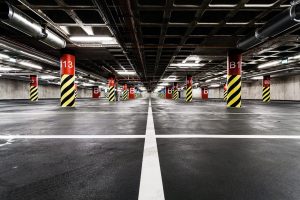
Parking garages benefit significantly from connected lighting due to fluctuating occupancy. Systems can:
- Increase brightness when vehicles or pedestrians are present
- Reduce light levels in unused areas
- Improve safety while lowering operating costs
This approach is especially effective for municipal facilities, hospitals, airports, and mixed-use developments.
Hallways and Corridors
In large commercial buildings, hallways and corridors are among the most consistently overlit spaces. Because these areas must meet safety and code requirements at all times, lighting is often left at full output, even during long periods of low or no occupancy. Over time, this results in unnecessary energy use and inflated operating costs.
Connected lighting transforms corridors from static, always-on environments into intelligent, responsive spaces. With networked controls, facility managers can implement:
- Automated lighting schedules that align with building hours and traffic patterns
- Zone-based controls that allow different corridor sections to operate independently
- Reduced light output during low-use periods, such as overnight hours or weekends
Lighting levels can automatically increase when motion is detected and dim back down once the space is vacant, ensuring safety and visibility are never compromised. Importantly, these systems are designed to maintain compliance with applicable building and life-safety codes while still delivering measurable energy savings.
The result is a more efficient lighting strategy that reduces waste, lowers utility costs, and extends fixture life without impacting the occupant experience.
Warehouses & Industrial Facilities
Warehouses and distribution centers are ideal candidates for connected lighting, thanks to their large footprints, high ceilings, and highly variable usage patterns. Traditional high-bay lighting systems are typically designed for worst-case scenarios, operating at full brightness regardless of whether aisles are occupied or tasks are being performed.
Connected lighting introduces intelligence at scale. High-bay fixtures can respond dynamically to:
- Motion within aisles and storage rows
- Task-specific work zones, such as packing, loading, or inspection areas
- Shift schedules, including partial staffing, overnight operations, or seasonal demand
When integrated properly, lighting output increases instantly when workers enter a space and safely dims when areas are unoccupied. This not only reduces energy consumption, but also improves visibility exactly where and when it’s needed.
Beyond efficiency, connected lighting provides a foundation for operational flexibility. As layouts change, inventory shifts, or new zones are added, lighting can be reconfigured through software rather than costly rewiring. This makes connected systems especially valuable for facilities planning future expansion.
Retail Spaces
Retail environments benefit from connected lighting through lighting schedules aligned with store hours and improved customer experience. Lighting can be adjusted to support merchandising, seasonal changes, or promotional events.
Office Buildings
Office lighting is no longer one-size-fits-all. Connected lighting allows:
- Zone-based or floor-level control
- Daylight harvesting near windows
- Integration with building management systems
This improves employee comfort while reducing unnecessary energy consumption.
Key Benefits of Connected Lighting for Commercial Buildings
Energy & Cost Savings
Energy efficiency is one of the primary drivers for connected lighting adoption in commercial buildings. By combining dimming, scheduling, and sensor-based control, facilities significantly reduce energy consumption. Lower energy usage translates directly into reduced utility bills and eligibility for utility rebates and incentives.
Reduced Maintenance Costs
Connected lighting systems optimize how fixtures are used, extending their lifespan. Additional benefits include:
- Fewer lamp replacements due to reduced run time and controlled output levels
- Reduced labor costs, as maintenance teams spend less time on routine checks and replacements
- Remote diagnostics and alerts that identify issues before failures occur, minimizing emergency service calls
- Predictive maintenance insights that help teams schedule service proactively instead of reactively
- Centralized system monitoring, allowing multiple facilities or zones to be managed from a single dashboard
- Less disruption to operations, since maintenance can be planned during low-impact windows
- Improved asset tracking and reporting, supporting budgeting, compliance, and long-term planning
Improved Safety & Security
Lighting plays a major role in maintaining safe and secure environments. Connected lighting enhances illumination in high-traffic and high-risk areas while improving visibility in locations such as parking areas and stairwells. Motion-activated lighting ensures spaces are well lit precisely when activity is detected, increasing awareness and responsiveness without unnecessary energy use. In addition to supporting occupant safety, well-lit environments serve as a powerful deterrent to unwanted activity, helping facilities maintain a safer and more secure setting overall.
Operational Efficiency
Managing lighting across multiple buildings or locations becomes far simpler with connected systems. Facility teams benefit from centralized control dashboards, remote access for adjustments, and less manual intervention. This frees up time and resources for higher-value tasks.
Scalability & Flexibility
Connected lighting systems are designed to grow with your facility. Expansion is typically handled through:
- Software updates
- Additional fixtures or sensors
- Reconfiguration of zones
- Support for phased rollouts, allowing upgrades to be implemented over time as budgets allow
- Easy adaptation to space repurposing
- Centralized control across multiple locations, enabling consistent lighting strategies enterprise-wide
- Reduced dependence on electrical rework, minimizing downtime and installation costs
- Future-ready infrastructure that supports integration with other smart building systems
This avoids costly rewiring or system replacements down the line.
Is Connected Lighting the Right Retrofit Solution?
Not every building is the same, and successful commercial lighting retrofits require careful evaluation. Key factors to consider include:
Energy Savings Potential
One of the most compelling reasons to consider connected lighting is the opportunity for substantial reductions in energy use. Traditional lighting systems often run at full power regardless of occupancy or natural light availability, wasting electricity and driving up utility costs. Connected lighting controls, including occupancy sensors, daylight harvesting, and automated dimming, tailor illumination to real needs. Research shows that occupancy-based controls alone can reduce lighting energy use by 20% to 60% in many commercial spaces, and combined lighting control strategies can achieve similar or higher savings depending on usage patterns and system design.
Maintenance Costs
Connected lighting systems can significantly reduce what facilities spend on routine maintenance. With traditional systems, lamps and fixtures are often replaced on a fixed schedule or only when they fail, which leads to regular labor costs and unplanned downtime. Connected lighting shifts this model by optimizing how often lights are used, extending the lifespan of LEDs and other components, and providing remote health monitoring and diagnostics that alert facility teams before failures occur. This predictive approach reduces emergency service calls, decreases the need for frequent lamp replacement, and allows maintenance resources to be allocated more efficiently
Safety and Compliance Needs
Lighting is foundational to building safety and compliance. In areas such as parking zones, walkways, stairwells, and exterior entrances, adequate illumination isn’t just about comfort; it’s often a code requirement and a liability concern. Connected lighting ensures that these critical zones are always illuminated to required levels when occupied, while still allowing energy savings when spaces are unoccupied. Motion-activated lighting in security-sensitive areas also enhances safety by deterring unwanted activity and improving visibility for occupants and security personnel.
Building Usage Patterns
Facilities with variable occupancy patterns typically see the greatest return on connected lighting investments. In these environments, lights are frequently on when they aren’t needed, or they fail to respond quickly to changing traffic flows. Connected lighting adapts dynamically to real-time usage, ensuring that lights are on only when and where they are needed and at appropriate output levels.
Budget and ROI Timeline
When evaluating connected lighting, decision-makers must balance upfront investment against long-term operating savings. Connected systems may involve a higher initial cost than traditional fixtures, but the efficiency gains often drive payback in a relatively short timeframe. Some case studies of controlled lighting retrofits show compelling payback periods, often within 1–3 years, when both energy and maintenance savings are accounted for, and when utility rebates or tax incentives are leveraged. Because connected lighting also reduces heat output compared to older systems, it can indirectly lower HVAC loads, adding to total operational savings.
Connected Lighting Solutions from Trusted Manufacturers
Bay Lighting works with industry-leading connected lighting platforms that are well-suited for commercial buildings in MD, DC, and VA.
Satco – Domino® Connected Lighting
Satco’s Domino platform offers a scalable, wireless connected lighting solution ideal for commercial retrofits. It supports indoor and outdoor applications and delivers a strong balance of performance, flexibility, and cost efficiency.
RAB Lighting – Lightcloud Blue
Lightcloud Blue is a cloud-based connected lighting control system known for reliability and ease of use. It is especially effective for parking lots, parking garages, and large commercial facilities, offering robust dashboards and remote management.
Keystone Technologies – SmartLoop
SmartLoop is designed to simplify both retrofits and new installations. It integrates lighting and controls into a streamlined ecosystem that supports zoning, scheduling, and occupancy sensing with minimal complexity.
Why Partner with Bay Lighting for Connected Lighting Projects
Choosing the right system is only part of the equation. Execution matters just as much. Bay Lighting brings deep expertise in commercial lighting retrofits, system design, and connected lighting deployment across Maryland, Washington DC, and Virginia. The goal is not just to install connected lighting, but to ensure it delivers measurable results.
Making the Smart Move Toward Connected Lighting
Connected lighting is more than a technology upgrade. It’s a long-term investment in efficiency, safety, control, and adaptability. For commercial properties across the Mid-Atlantic, it offers a practical path toward smarter operations and lower costs.
By choosing the right connected lighting system and the right partner, commercial buildings can future-proof their lighting infrastructure while delivering immediate operational benefits. Any commercial lighting upgrade is an opportunity to think smarter, not just brighter. If you’re planning a commercial lighting project in Maryland, DC, or Virginia, connected lighting deserves a serious look. Contact Bay Lighting to learn more.